

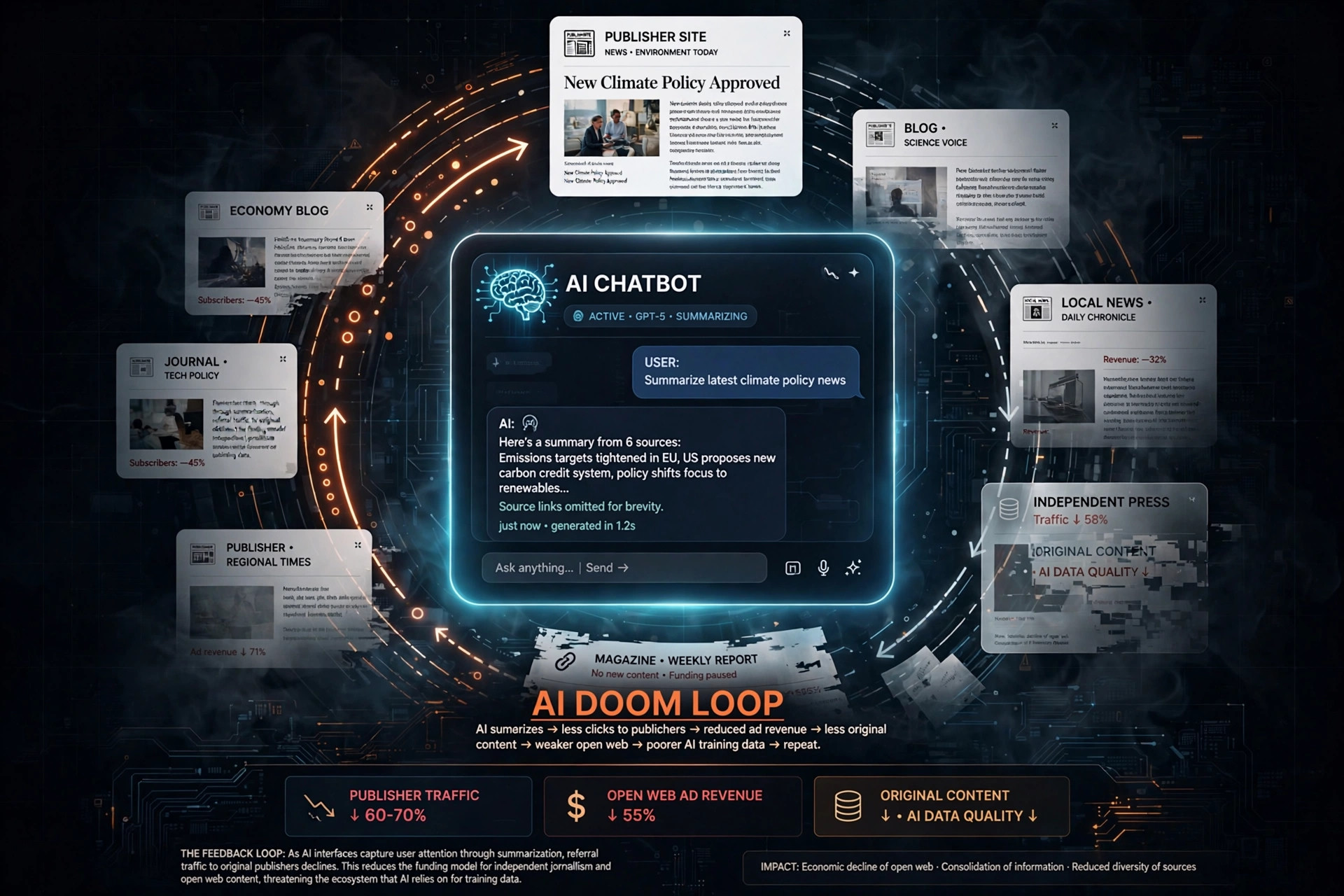
Microsoft knew the risk early. Internal documents disclosed in The New York Times lawsuit against Microsoft and OpenAI describe company concerns that its own AI products could start a self-reinforcing cycle that harms the websites those products depend on. The phrase used inside the company, according to the documents, was a doom loop for the open web.
The logic is straightforward. AI systems learn from human-made material published online: reporting, photography, music, design, video and writing. When an AI assistant then answers a question directly, the user may never visit the original site. Fewer visits mean less advertising, fewer subscriptions and less money to pay the people who produced the material in the first place. If less original material is made, the web that future models learn from becomes thinner and less reliable.
How the Loop Feeds Itself
For decades, the basic bargain of the web was an exchange of traffic. Search engines indexed publisher content, publishers received readers, and readers could go deeper, subscribe, buy something or see advertising that funded the next piece of work. AI-generated answers change that exchange because the answer itself becomes the destination. A summary may be convenient, and for many simple questions it is enough, but convenience for the reader can mean lost income for the source.
The internal warning, as described in the disclosed material, was that this is unusual in business. A product normally does not weaken the economic foundations of its own suppliers. Here, the suppliers are millions of independent sites, newsrooms, creators and specialists whose work is rarely produced under contract for an AI company, yet whose output gives those companies something valuable to summarise, quote and learn from.
Publishers are the clearest example, but they are not the only ones affected. Musicians, illustrators, filmmakers, photographers and small specialist sites face the same pattern: their work helps train or populate systems that then compete for the audience and income that sustained them. That is why the warning has resonated well beyond one court case.
Why Small Sites Feel It First
Large publishers can negotiate licensing deals, invest in legal teams or build direct relationships with loyal subscribers. A small site usually cannot. It relies on search referrals arriving steadily, and even a modest fall in click-through can decide whether new work gets commissioned at all. Practical guides such as A Practical Content Workflow for Home and Family Websites assume that traffic can be turned into a sustainable routine. If the traffic stops at an AI answer, that routine breaks.
The damage is also cumulative and hard to see in a single month. A site publishes less often, archives stop growing, experts move to other work, and the range of fresh, first-hand material available online narrows. Models trained or refreshed on a narrower web can then become more repetitive and more dependent on a small number of dominant sources. Users may notice the result as answers that feel hollow, recycled or strangely similar wherever they look.
What Could Break the Cycle
There is no single fix, but the documents point to the areas where action is already under way. First, the courts. The Times case is about far more than one publisher’s archive; by bringing internal communications into the open, litigation is forcing a public discussion about what AI companies knew, when they knew it, and what responsibility follows from that knowledge. Other copyright claims are testing similar questions for images, books and music.
Second, licensing and payment models could be rebuilt so that sources are compensated when their work is used to generate an answer, not only when a reader clicks through. That would require reliable attribution, measurable usage and agreements that work for small publishers as well as large media groups. Voluntary deals between a few big names will not solve the problem for the long tail of the web that gives it much of its breadth.
Third, product design matters. Clear citations, prominent links and answers that encourage readers to visit original reporting for detail can preserve part of the old traffic bargain. So can tools that let site owners control how their material is used, and transparency about when content has been used for training or live answers.
Finally, publishers themselves are adapting: building newsletters and communities that do not depend on search, offering memberships, and producing original reporting, data and local knowledge that a generic summary cannot replace.
The significance of the Microsoft documents is not that one company identified a flaw in its strategy. It is that the flaw was recognised from inside, in plain language, before the effects became impossible to ignore. Whether the industry now changes course, through law, licensing or design, will determine whether AI becomes a new route to the open web or the mechanism that quietly starves it.
