

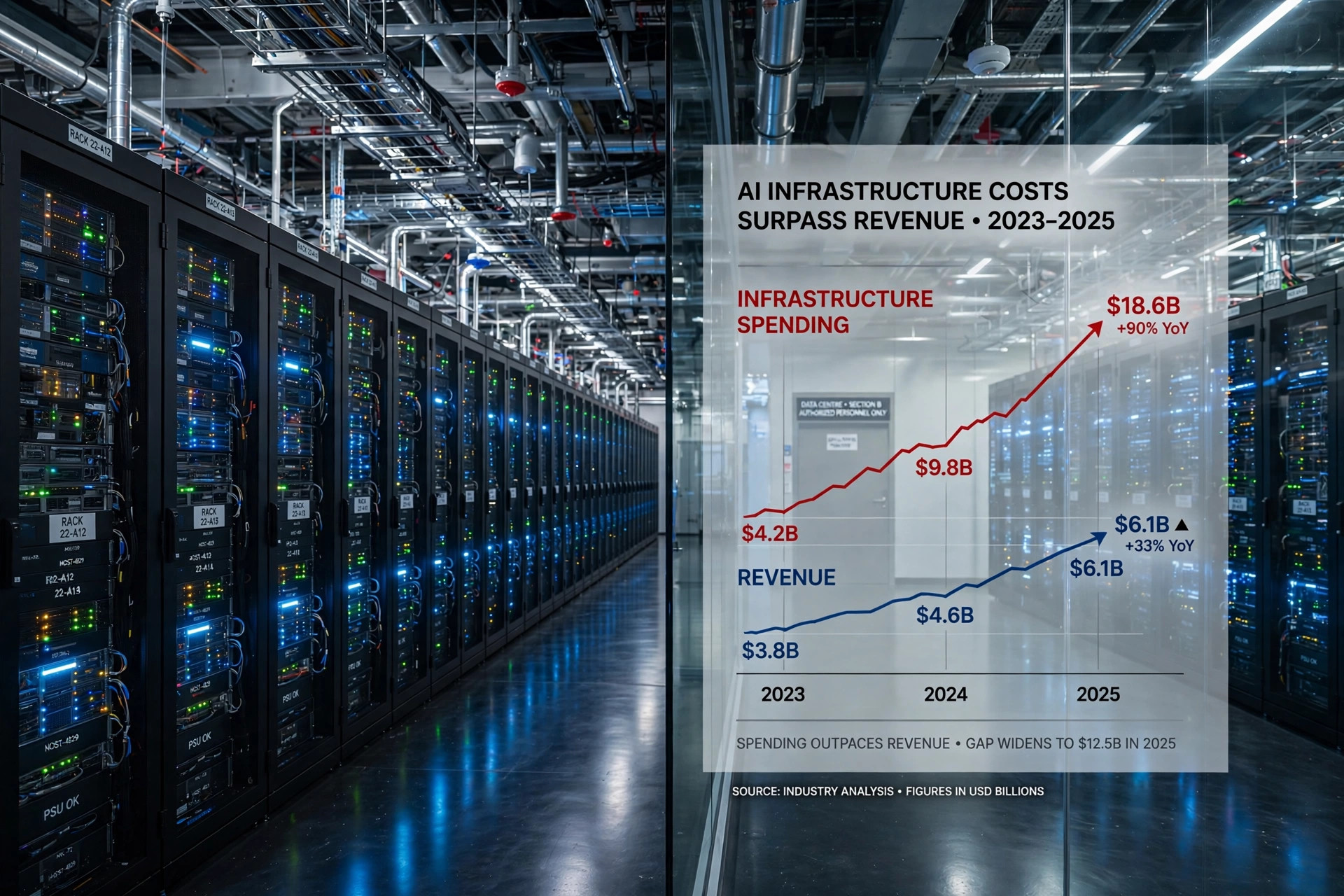
The boom in artificial intelligence has produced a simple but uncomfortable question for the companies building it: will the money coming in ever match the money going out? A new forecast from Gartner suggests that, on current plans, it will not. The analyst firm expects spending on AI infrastructure to run far ahead of the revenue that enterprise and consumer AI services are likely to generate this decade, leaving some operators exposed to large write-downs and a wave of consolidation.
As reported by The Register, Gartner estimates that AI providers will spend nearly $1 trillion on infrastructure in 2026 alone, followed by a further $6 trillion between 2027 and 2030. Against that outlay, the firm puts the revenue attributable to AI data centres over the same period at no more than $3.6 trillion.
A Gap Measured in Trillions
The shortfall becomes clearer when a normal commercial hurdle is applied. Using a 12 percent return on invested capital, a threshold many companies treat as acceptable, Gartner calculates that operators would need about $8.5 trillion in revenue to cover their capital spending and financing costs. Forecast revenue falls well short of that figure, which means many planned facilities would not earn back their cost on the timetable investors expect, even if demand for AI services keeps growing strongly.
That distinction matters. The forecast is not saying that AI has no customers, or that demand will disappear. It is saying that the pace and scale of construction have moved ahead of the proven market. Data centres are long-lived, expensive assets that must be paid for whether utilisation is high or low. If newer chips arrive before older hardware has paid for itself, the value of that earlier equipment can fall quickly, forcing owners to recognise losses.
Gartner’s wider report warns that capital write-downs linked to this overbuild could exceed $4 trillion by 2032. In other words, the risk is not a single bad quarter. It is a long adjustment in which assets bought at the height of enthusiasm are revalued against more modest earnings.
Why Neoclouds Face the Sharpest Risk
The firms most exposed, according to the forecast, are the so-called neoclouds: specialist providers that rent out GPU capacity for AI training and inference. Gartner expects about 80 percent of them to disappear as standalone businesses by 2030, through closure, acquisition or absorption into larger groups. Their model is concentrated by design. If GPU rental prices fall, or if a handful of large customers bring capacity in-house, there is little else in the business to cushion the blow.
Consultants have been making a similar point for some time. Smaller infrastructure providers have been urged to move beyond raw compute, add software and managed services, and diversify their customer base before compute becomes a commodity priced mainly on power and availability. Those that cannot differentiate will compete on price against rivals with far deeper balance sheets.
For readers who run smaller online operations, the lesson is familiar even at a very different scale: sustainable growth depends on workflow and cost discipline, a point explored in A Practical Content Workflow for Home and Family Websites. In AI infrastructure, that discipline is now being tested in billions rather than in household budgets.
Hyperscalers Have Other Lines to Fall Back On
The largest cloud companies are better placed to ride out a shake-out, Gartner argues, because AI is only one part of much broader businesses. They sell storage, databases, security, productivity software and conventional cloud hosting alongside AI capacity, and they can shift hardware between internal projects and external customers. A disappointing return from one generation of accelerators is painful for them, but it is rarely existential.
That advantage may deepen consolidation. If specialist providers struggle to refinance, the hyperscalers and a few well-funded rivals are the natural buyers of their sites, power contracts and customer lists. Customers could benefit in the short term from lower prices as capacity is discounted, but they would also face a more concentrated market later, with fewer independent alternatives.
Lenders Are Asking Harder Questions
Financial markets have already shown signs of unease about the cost of the build-out. Reporting cited in the coverage notes higher borrowing costs for some backers of large AI projects, and separate analyst work this month has questioned whether leading model developers can defend their margins against cheaper open-source and Chinese models. Other consultancies have reached a similar conclusion to Gartner’s from the opposite direction, estimating that the industry would need far larger annual revenues by the early 2030s to justify the infrastructure required to meet expected demand.
International bodies have also warned that a sharp correction in AI valuations could spill into the wider economy, given how much investment, credit and stock-market value now depend on a relatively small group of technology companies.
None of this guarantees a crash, and Gartner itself notes that some operators will outperform. Power-rich sites, efficient designs, long-term customer contracts and disciplined borrowing can still produce solid returns. But the central message is hard to ignore: building capacity is no longer enough on its own. The next phase of the AI race will be won by companies that can turn expensive infrastructure into durable, paying demand before the financing, and the hardware, run out.
