

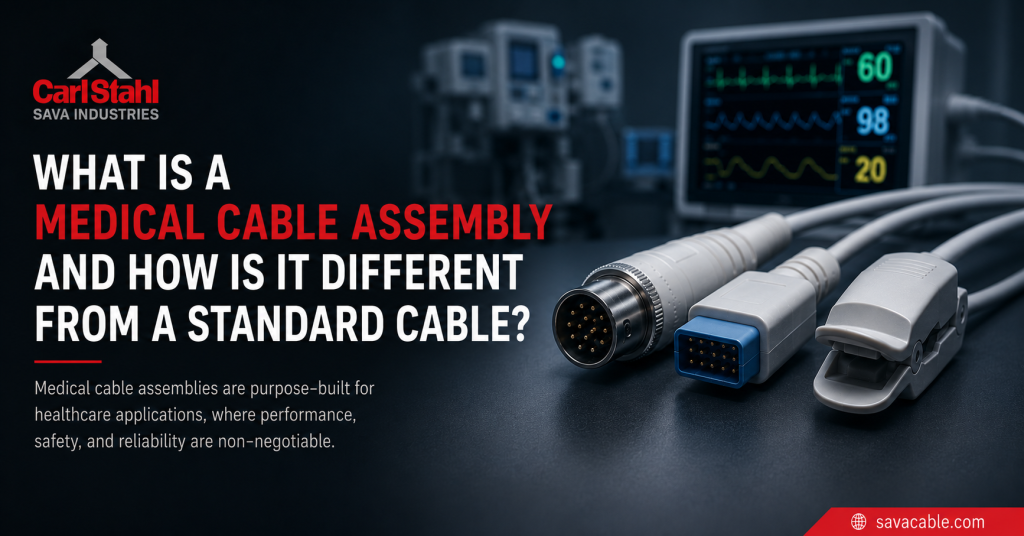
When engineers and procurement teams specify cables for medical devices, they quickly discover that not all cables are created equal. A medical cable assembly is not simply a standard cable with a new label, it is a purpose-engineered component built to meet an entirely different level of precision, biocompatibility, and regulatory compliance. Understanding the distinction matters enormously, because the wrong choice can compromise device performance, patient safety, and regulatory approval.
In this article, we break down exactly what a medical cable assembly is, how it differs from a conventional cable, and why those differences are non-negotiable in clinical and surgical environments.
What Is a Medical Cable Assembly?
A medical cable assembly is a precision-engineered cable system designed specifically for use in medical devices, surgical instruments, and diagnostic equipment. Unlike general-purpose cables, these assemblies are built to exacting specifications that govern every variable from the alloy composition of the wire strands to the coating chemistry, tensile strength, bend radius, and end-fitting geometry.
At their core, custom medical cable assemblies are fully integrated systems. They combine the cable itself with bare or coated wire rope in miniature or standard diameters with precisely engineered fittings, terminations, and end connectors, all assembled to a specific dimensional and mechanical specification.
Applications span a broad range of medical technology, including:
- Surgical robotic systems that require ultra-precise motion transmission
- Endoscopic and laparoscopic instruments where tight bend radii and miniature diameters are critical
- Minimally invasive surgical tools where cable performance directly affects surgeon control
- Diagnostic and patient monitoring devices
- Implantable or body-adjacent components where material biocompatibility is required
How Medical Cable Assemblies Differ from Standard Cables
The differences between a medical cable assembly and a standard industrial or commercial cable are not cosmetic. They extend across material selection, manufacturing tolerances, cleanliness standards, traceability, and regulatory compliance.
1. Materials and Biocompatibility
Standard cables are typically manufactured from galvanized steel or basic stainless steel grades chosen for cost-efficiency and load-bearing capacity. Medical applications demand far more. Cables used in or adjacent to the human body or inside instruments that enter the body must be made from biocompatible, corrosion-resistant materials that can withstand repeated sterilization cycles.
Common materials used in medical cable assemblies include:
- 316L stainless steel highly corrosion-resistant, widely used in surgical instruments
- Tungsten preferred for surgical robotics due to its exceptional strength-to-diameter ratio and radiopacity
- Nitinol a shape-memory alloy used in minimally invasive tools for its flexibility and kink resistance
- Titanium and Vitallium® selected for implant-adjacent or high-biocompatibility applications
Manufacturers of standard cables rarely stock or process these exotic materials. A specialist medical cable manufacturer maintains validated supply chains, material certifications, and process controls for each.
2. Dimensional Precision and Tolerances
Standard cables are manufactured to commercial tolerances that allow for reasonable variation in diameter, lay length, and breaking strength. Those tolerances are acceptable when a cable is pulling a mechanical load in an industrial machine. They are not acceptable when a cable is actuating a surgical instrument inside a patient.
Medical cable assemblies are manufactured to tolerances measured in thousandths of an inch. Diameter consistency across the cable length, precision in strand count and lay angle, and exact fitting dimensions all affect how the instrument behaves in the surgeon’s hand. Even minor variation can affect motion transmission fidelity, an unacceptable risk in surgical robotics or endoscopic applications.
3. Cable Construction and Miniaturization
Many medical applications require cables that are far smaller than anything a standard commercial cable manufacturer produces. Miniature and precision small cables with diameters as fine as 0.008″ are routinely used in endoscopic instruments and minimally invasive surgical tools, where the internal lumen of the device places hard limits on cable diameter.
Construction choices whether 1×7, 7×7, or 7×19 stranding, for example affect flexibility, tensile strength, and minimum bend radius in ways that must be precisely matched to the application. A medical cable assembly manufacturer will engineer the construction to meet all three requirements simultaneously, often a challenge that a standard cable supplier cannot address.
4. Coatings and Lubrication
Standard cables may be coated for environmental protection or to reduce abrasion. Medical cables are coated when coated at all with materials selected specifically for biocompatibility, sterilizability, and functional performance. Coated stainless steel cable used in medical devices may be coated with PTFE (Teflon®), nylon (PA), or polyurethane, each chosen for its specific combination of low friction, chemical resistance, and compatibility with autoclave sterilization or EtO gas processes.
Some medical cables incorporate lubricant-impregnated nylon coatings that extend cable service life dramatically compared to uncoated alternatives, a meaningful consideration in reusable surgical instruments.
5. End Fittings and Terminations
A cable assembly is more than wire rope; it includes the end fittings and terminations that attach the cable to the device. In medical applications, these fittings must be manufactured to the same biocompatible standards as the cable, with geometries precisely matched to device interfaces. Wire rope fittings for medical use including ball ends, swage fittings, threaded plugs, and custom terminations must be dimensionally exact and manufactured with documented process controls.
In contrast, standard commercial fittings are available off the shelf and chosen for compatibility with general hardware, not precision device integration.
6. Cleanliness and Contamination Control
Medical cable assemblies are manufactured in controlled environments where contamination is managed at every step. Drawing lubricants used during wire manufacturing, residual surface oils, and particulate contamination all require controlled cleaning processes before an assembly is acceptable for medical use.
Standard commercial cable manufacturers have no such requirement. Their product is shipped ready for general industrial use, where cleanliness to medical standards is irrelevant.
7. Traceability, Documentation, and ISO Certification
Perhaps the most significant operational difference is in traceability and documentation. Medical device OEMs operate under FDA regulations (21 CFR Part 820) and ISO 13485 quality management requirements. Every component in their device including cable assemblies must have documented material traceability, process records, and quality certifications.
A qualified medical cable assembly manufacturer operating under ISO 9001:2015 or ISO 13485 maintains complete material certifications, first article inspection records, dimensional inspection data, and traceability for every assembly shipped. This documentation infrastructure is what allows OEMs to support their own regulatory submissions.
Standard cable suppliers typically cannot provide this level of documentation.
Why These Differences Matter for OEM Engineers
For engineers designing medical devices, these distinctions translate directly into device performance, regulatory risk, and time-to-market. Using a standard cable where a medical-grade assembly is required can lead to:
- Premature cable fatigue or failure in cyclic-load applications like surgical robotics
- Corrosion from repeated sterilization cycles that standard cable materials cannot withstand
- Failed regulatory audits due to inability to provide material traceability or certificates of conformance
- Dimensional inconsistencies that affect device function and surgeon experience
- Biocompatibility failures in body-adjacent applications
Engineering a cable assembly for a medical device is not a purchasing exercise it is a design collaboration between the OEM’s engineering team and a cable manufacturer with deep domain expertise.
Choosing the Right Medical Cable Assembly Manufacturer
Not every cable manufacturer has the capability, materials, or quality systems to serve the medical device market. When evaluating a supplier, OEM engineers should look for:
- ISO 9001:2015 certification with documented quality management systems
- Experience with biocompatible materials including surgical-grade stainless steel, tungsten, nitinol, and titanium
- In-house capability for custom termination, fitting swaging, and assembly
- Complete material traceability and lot documentation
- Demonstrated experience with surgical robotics, endoscopic, and laparoscopic applications
- Engineering support for cable selection, construction specification, and prototype development
Sava Cable has been manufacturing custom medical cable assemblies for medical device OEMs since 1974. As an ISO 9001:2015 certified manufacturer, Sava brings over 50 years of precision cable engineering experience to applications ranging from surgical robotics to endoscopic instruments, with full material traceability, in-house fitting fabrication, and engineering support for each project.
The Bottom Line
A medical cable assembly and a standard cable may look similar on paper, but they are fundamentally different products. From the alloy in the wire strands to the documentation in the quality record, every aspect of a medical cable assembly is engineered to meet the unique demands of medical device applications that standard commercial cables simply cannot satisfy.
For OEMs developing surgical robots, endoscopic instruments, or any device where cable performance directly affects patient outcomes, partnering with an experienced medical cable manufacturer is not optional, it is essential.
